Dear colleagues in the MaterialDigital community,
with this fourth and final newsletter of the year, we would like to look back on the most recent general assemby and summarize the key points for you once again. We would like to thank the more than 170 participants whose enthusiastic contributions and active participation shaped the event and contributed to a dynamic exchange within the MaterialDigital community—we are delighted that you were there!
At the 2025 MaterialDigital General Assembly, the community engaged in intensive discussions about current developments in Workflows, IT Architecture, and Semantic Interoperability. New demonstrators, workshops, and the release candidate of PMD Core Ontology 3.0 showcased the initiative's dynamism and collective progress.
The three-day MaterialDigital General Assembly took place at the end of November at BAM in Berlin. Once again, offered the community a central platform for exchange, networking, and the presentation of current developments.
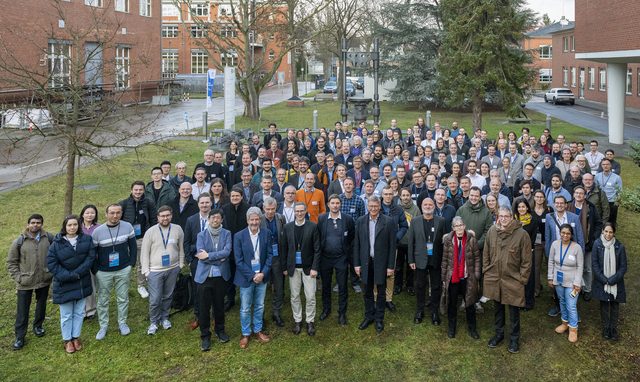
The first event day was kicked-off with contributions from BAM, BMFTR (Federal Ministry of Research, Technology and Space), and the MaterialDigital Platform, as well as guest lectures on digital transformation of technology. The followed-up demonstrator and poster session encouraged direct dialogue between MaterialDigital projects, industry, and the research community. All posters submitted online are available after registration in the download area of the PMD website and on the respective project websites.
The activities of the various PMD Project Partners were the main focus on the second day. The MaterialDigital 2 and 3 projects presented their work in parallel sessions. There were a total of 15 talks, so it was not easy to choose between the parallel presentations – we would like to thank all the speakers for their interesting contributions. PMD also presented key developments in the areas of semantic interoperability, workflows, and architecture & IT infrastructure. Details about these presentations and offers can be found further down in the newsletter. With EdCar and PMD-X-MAPRO, the first PMD-X projects were launched in 2025; their contributions were an important enrichment with regard to the X world. All presentations that have been approved for release are also available on the project websites and in the download area.
The third day was devoted to workshops covering topics such as the further development of the PMD Core Ontology, the integration of tools into the workflow ecosystem, and issues relating to IT architecture and data integration. Further links from the workshops can also be found below in the respective reviews of the technical focus areas.
Overall, the plenary session demonstrated strong participation and lively discussions. The large number of demonstrators and posters, the intensive exchange, and the visible progress in key components of the initiative underscored the growing momentum and joint progress of the community. We would like to thank all participants once again.
At the General Assembly, the growing importance of workflows for MaterialDigital activities over the past year became apparent. In a special issue of Advanced Engineering Materials published at the beginning of 2025, a comprehensive workflow article highlighted that the interoperability of workflows is a topic that concerns almost all MD projects. During the General Assembly, participants were able to discuss in more concrete terms than at the time of publication of the article how the activities of different communities within MaterialDigital can be linked interoperably through workflow developments.
The discussion of FAIR (Findable, Accessible, Interoperable, Reusable) workflows began in the opening presentation and continued throughout the technical presentations and workshops over the following days. The broad spectrum of demonstrable advantages now included examples:
It is now possible to perform all these tasks within the same workflow environment.
Most of these developments could be demonstrated using pyiron as an example. The conversion of pyiron to a version in which individual workflow steps (called nodes) are represented by separate Python functions was particularly effective. This type of functional programming not only has the advantage of making complex workflow structures easier to implement. It also makes working with workflows based on a graphical user interface particularly user-friendly. However, this approach is particularly suitable for the desired interoperability between workflow management systems, which can now be achieved based on the Python Workflow Definition. This makes it possible to create workflows in a preferred management system and run them in the workflow management system supported by the PMD architecture (or vice versa).
The latter also includes SimStack, which was presented at the General Assembly in a new version based on a modern web portal. This version automates and streamlines the tracking and reuse of data from individual workflow steps, which is also an essential foundation for complex data analyses based on complex workflows.
However, in order to make workflow interoperability automatable and validatable, semantic annotation of workflow nodes is an important prerequisite. Various concepts for this have been discussed within a dedicated PMD working group for some time. At the General Assembly, however, it was possible for the first time to show how this can be implemented within the framework of Semantikon in accordance with PMD Core Ontology Version 3.0. This means that the knowledge graphs automatically generated from the associated workflows are also compatible with the PMD Application Ontologies (AO), which offers a wide range of opportunities for collaboration between MD projects. These opportunities were presented in detail during a hands-on workshop on the last day of the plenary meeting.
Various other topics from the above list, such as the use of workflows for describing and controlling experimental processes and the use of language models for generating workflows, were also addressed during the General Assembly and considered worthy of further discussion. This suggests that workflow activities at MaterialDigital will pick up speed in the coming year. In order to meet this need beyond PMD and national interests, it has now been decided to establish a new discussion and presentation format for workflows, which will be similar to the Ontology Playground. Organizational workflow issues within MaterialDigital will continue to be discussed on Fridays. The joint hackathons organized by this group, which proved useful on several occasions in 2025, will also be continued in 2026. You are warmly invited to all these events, which will be advertised on the PMD website.
At this General Assembly, participants were presented with a complete working example of the PMD infrastructure and the toolbox based on it. On the one hand, this includes the DataPortal as a platform supported by the PMD for publishing data sets and related artifacts.On the other hand, the use of the PMD mesh was demonstrated, which, in conjunction with other tools, serves as a save collaboration environment for project-related handling of materials science data.
During the architecture workshop, participants were shown specifically how they can work in both environments.
The workshop also provided an opportunity to discuss the general structure and components of the PMD server and answer questions on this topic:
Overall, this workshop was a complete success, and we hope that more projects will now be encouraged to apply the concepts developed by the PMD.
The MaterialDigital General Assembly impressively demonstrated the importance of semantic interoperability in the digital transformation of materials science and engineering. Numerous contributions from industry made it clear that semantic technologies are no longer just a research topic, but are increasingly becoming essential for data-based value creation in real-world applications.
Presentations on the Digital Footprint, Material Data Management, and applications in glass development made it clear that the industry demands and needs semantically networked data spaces in order to make processes more efficient, sustainable, and interoperable. This strong demand is a significant driver and motivator for our further developments within the MaterialDigital platform.
A key item on the agenda was the presentation of the Focus Area - Semantic Interoperability, which included the newly released PMD Core Ontology (PMDco) Version 3.0.0-rc1. The focus was primarily on structural innovations, enhancements to the content model, and improved documentation and usage concepts.
In addition, a practice-oriented workshop on semantic interoperability was held, focusing on the use of PMDco. After a concise introduction to ontology development, key use cases and concepts of PMDco were developed together with the participants. They deepened their understanding of how to use PMDco by means of a hypothetical high-temperature tensile test: By reusing PMDco, they discovered how relevant terms and concepts can be structured at the mid-level and application ontology level and developed a small knowledge graph for the example process instance. The aim was to further promote the transfer to projects and the application in real workflows. As usual, accompanying information and working materials for the PMDco workshop are available in the corresponding GitHub repository.
The event has once again demonstrated that the community is growing, communication is active, and the joint development of the PMDco is progressing steadily. We kindly invite all interested parties to continue providing constructive feedback and to actively participate in the orientation and design of semantic interoperability in MaterialDigital.
The development of the latest version of the PMD Core Ontology (PMDco) shaped the entire year 2025. A key milestone was the publication of the release candidate on November 25, 2025, which will ultimately lead to the final release of version 3.0.0 at the end of January 2026.
A total of 51 issues were closed and 801 commits were implemented — an impressive proof of the high level of work involved, the intensive culture of discussion and curation, and the community's attention to detail.
At the same time, 54 issues remain open, which shows that development will continue at full speed in the coming year.
The publication followed a clearly structured release roadmap:
| Date | Milestone |
|---|---|
| 20.03.2025 | Release PMDco Version 3.0.0-alpha1 |
| 25.11.2025 | Release Candidate Version 3.0.0-rc1 |
| 31.01.2026 | Final Release PMDco 3.0.0 |
In addition, particular emphasis was placed on documentation. This has been comprehensively revised and modernized.
It contains among others:
The Ontology Development Kit (ODK) was also introduced across the board for the development and publication of all ontologies within the PMD framework.
Starting with PMDco itself a (GitHub-Repo, it is now also used in the connected domain and application ontologies (AO) GitHub-Template.
The template makes it easy to create an AO, e.g., by forking the repository—instructions can be found in the repository.
In addition to the PMDco, the prototypical application ontologies of PMD have also been intensively developed. They now follow the latest PMDco version. Available ontologies include:
Additionally, independent repositories have been published for PMDco modules, such as for the Logistics Application Ontology.
The 3rd PMD Ontology Hackathon contributed significantly to the further development of PMDco. The community met for two days at BAM to take decisive steps toward improvement.
Various working groups worked among others on the following topics:
Results:
The event demonstrated the importance of open, creative, and collaborative cooperation for semantic interoperability in digitization in the field of materials science and engineering. Further information can be found in the GitHub repository dedicated to the hackathon.
We are already looking forward to the next hackathon, which is planned for Fall 2026. There you will also have the opportunity to meet some of our new team members in person.
To stay well informed about topics related to ontology, we would be delighted to welcome you to the PMD Ontology Playground. This low-threshold event series offers presentations, discussions, and exchanges on ontologies and semantic technologies.
15 events with a total of around 400 participants underscore the high level of interest.
More information, such as links to recorded presentations, can be found in the corresponding GitHub repository.
If you are interested in participating, please use the link to register for the PMD Ontology Playground.
Would you like to know how the NFDI MatWerk Ontology uses PMDco as its basis? Then take a look at the following article:
Hossein Beygi Nasrabadi, Ebrahim Norouzi, Kostiantyn Hubaiev, Jörg Waitelonis, Harald Sack: NFDI MatWerk Ontology (MWO): A BFO-Compliant Ontology for Research Data Management in Materials Science and Engineering https://advanced.onlinelibrary.wiley.com/doi/10.1002/adem.202502331
Have the General Assembly and the report about it sparked your interest in engaging in more intensive exchanges with other PMD enthusiasts? Then we look forward to your lively participation in our open rounds:
More information, such as links to recorded Playground presentations, can be found in the corresponding GitHub repository. Perhaps we will be able to welcome a few new faces to the formats.
We would like to remind you once again about MSE 2026, which will take place in Darmstadt from September 29 to October 1. The topic of digitization will once again feature prominently in Topic D: Digital Transformation. The topic coordinators Tilmann Hickel, Chris Eberl, and Martina Zimmermann from MaterialDigital and NFDI-MatWerk look forward to receiving your contributions. The abstract submission period runs until January 31, 2026, so don't forget to submit your contributions in good time.
Until then, stay in touch with us: Follow us on LinkedIn and visit our Website.
If you have any questions, please do not hesitate to contact us at info@material-digital.de or via our direct contact persons.
We wish you a relaxing holiday season and a happy New Year, and look forward to many activities together in the coming year!
The PMD team